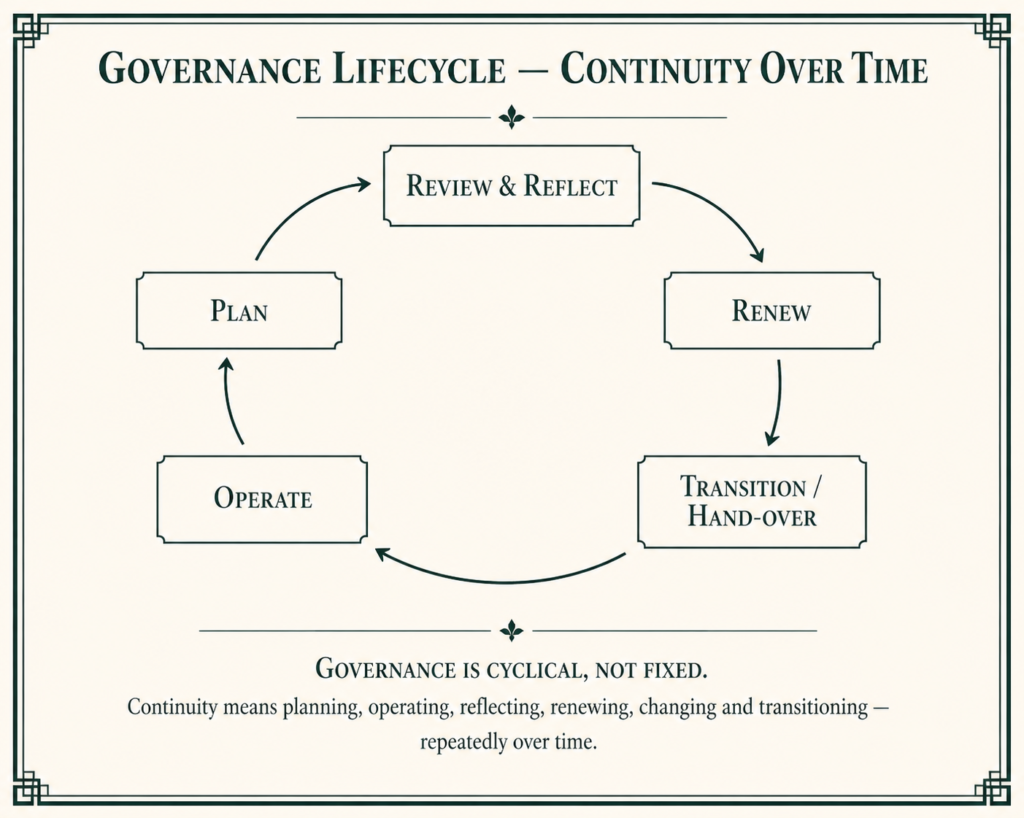
Governance Continuity
Te Toitūtanga o te Whakahaere
Ensuring the trust continues to function smoothly as people change — without loss of memory, intent, or momentum.
Kia haere tonu te mahi a te tarahiti ahakoa ka huri ngā tangata — me te kore e ngaro te mātauranga, te whakaaro, me te aronga.
Principle: People change — systems must endure.
Mātāpono: Ka huri te tangata — me mau tonu te pūnaha.
Why this matters
Te take e hira ai
Most governance failure does not come from bad decisions — it comes from handover gaps. When trustees leave, context leaves with them unless it is captured.
Ko te nuinga o ngā raruraru whakahaere ehara i te whakatau hē — engari nā te ngaro o te tuku mātauranga. Ina wehe ngā kaitiaki, ka wehe hoki te horopaki ki te kore e tuhia.
Insight: Continuity is not about control — it is about memory.
Kōrero matua: Ehara te toitūtanga i te whakahaere — he maumahara kē.
What breaks continuity
He aha ka pakaru ai
- Knowledge held only in individuals
- Decisions not formally recorded
- No structured trustee handover
- Repeated work across generations
- Kei roto anake ngā mōhiohio i ngā tangata
- Kāore ngā whakatau i tuhia
- Kāore he tukanga tuku kaitiaki
- Ka mahi anō ngā reanga hou i ngā mahi tawhito
GOP approach to continuity
Te huarahi GOP mō te toitūtanga
The GOP treats continuity as an operational responsibility, not a personality trait. Memory is written down, structured, and shared.
Ka titiro te GOP ki te toitūtanga hei kawenga whakahaere — ehara i te āhuatanga tangata. Ka tuhia, ka whakaraupapatia, ka tohatohahia te maumahara.
- Clear trustee roles
- Decision summaries retained
- Issues tracked over time
- Calm onboarding of new trustees
- He whakamārama mārama mō ngā tūranga
- Ka puritia ngā whakatau
- Ka whai tonu ngā take
- He urunga māmā mō ngā kaitiaki hou