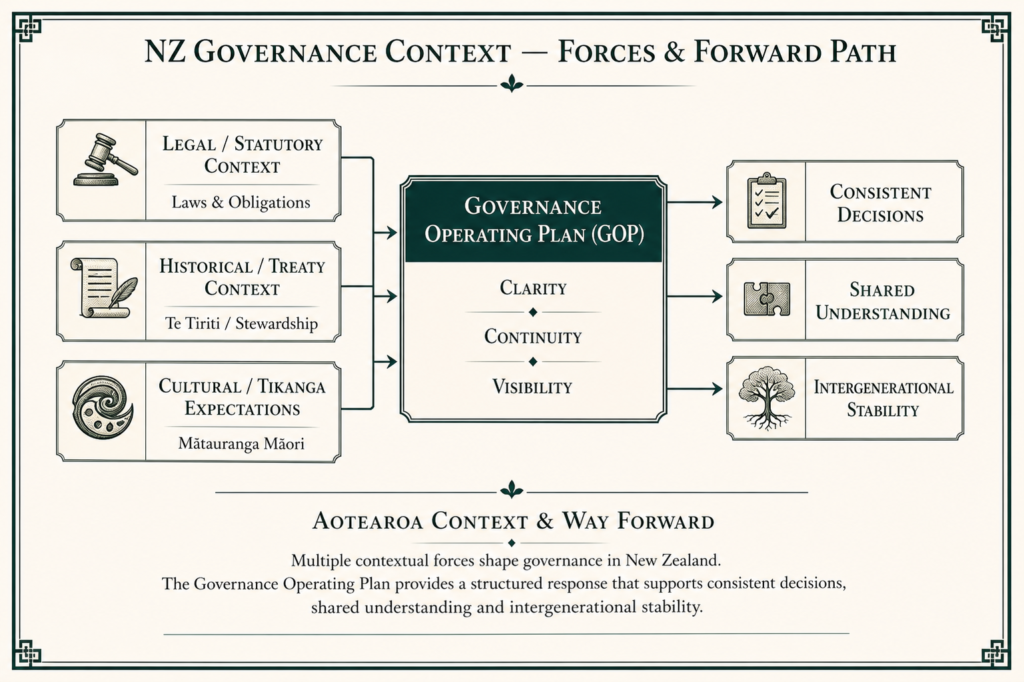
NZ Governance, Trusts & Māori Land — A Friendly Overview
Te Whakahaere i Aotearoa, ngā Tarahiti me te Whenua Māori — He Tirohanga Mārama
This page explains, in plain language, how New Zealand’s trust and Māori land governance systems developed, why shareholder registers often become difficult over time, and why modern governance requires a repeatable process.
Ka whakamārama tēnei whārangi, mā te reo māmā, i te whanaketanga o ngā pūnaha whakahaere tarahiti me te whenua Māori i Aotearoa, te take ka uaua haere ngā rēhita kaipupuri hea i te roanga o te wā, me te take me whai tukanga auau te whakahaere hou.
Purpose: to give context — not to place blame.
Te kaupapa: he tuku horopaki — ehara i te tuku whakahē.
1) Two Legal Systems Sit Side-by-Side
1) E Rua ngā Pūnaha Ture e Noho Tahi Ana
In New Zealand, governance in this space comes from two different legal “streams”:
I Aotearoa, ka ahu mai te whakahaere o tēnei wāhi i ngā ara ture e rua:
- General trust law based on English common law traditions
- Māori land law designed to protect Māori land ownership and retention
- Te ture tarahiti whānui, nō ngā tikanga common law o Ingarangi
- Te ture whenua Māori, i hangaia hei tiaki i te pupuritanga me te rangatiratanga o te whenua Māori
Why it matters: These systems have different goals. Confusion often arises when they are treated as the same.
He aha te take: He rerekē ngā whāinga o ēnei pūnaha. Ka puta te rangirua ina whakaarohia he ōrite rāua.
2) General Trust Law
2) Te Ture Tarahiti Whānui
For decades, many trusts operated under the Trustee Act 1956. It reflected an older style of trust governance: trustee-centric, conservative, and often low on transparency.
Mō ngā tekau tau, he maha ngā tarahiti i whakahaerehia i raro i te Trustee Act 1956. He āhua tawhito tōna: ko te kaitiaki kei waenganui, he tūpato, ā, kāore i tino kaha te mārama ki ngā kaiwhiwhi painga.
New Zealand later updated this framework with the Trusts Act 2019, strengthening expectations around record-keeping and beneficiary information.
Nō muri mai ka whakahoungia e Aotearoa tēnei anga mā te Trusts Act 2019, e whakapakari ana i ngā kawenga mō te pupuri rēhita me ngā pārongo mō ngā kaiwhiwhi painga.
Plain-English takeaway: Modern trust governance expects clearer records and better information handling than in the past.
Te kōrero māmā: Ko te whakahaere tarahiti hou e hiahia ana kia mārama ake ngā rēhita me te whakahaere pārongo.
3) Māori Land Law
3) Te Ture Whenua Māori
Māori land law has its own history. Earlier laws converted Māori land into individual titles, which led to fragmentation and alienation over time.
He hītori motuhake tō te ture whenua Māori. I ngā ture o mua, i hurihia te whenua Māori hei taitara takitahi, ā, nā tēnei i pakaru ai te rangatiratanga me te hononga ki te whenua i te roanga o te wā.
A major shift occurred with Te Ture Whenua Māori Act 1993, which prioritises keeping Māori land in the hands of its owners and their whānau.
He panoni nui i puta mai mā Te Ture Whenua Māori Act 1993, e aro nui ana ki te pupuri tonu i te whenua Māori ki ngā ringa o ngā rangatira whenua me ō rātou whānau.
Plain-English takeaway: Māori land law is not neutral property law — it is designed to protect retention.
Te kōrero māmā: Ehara te ture whenua Māori i te ture rawa noa iho — he ture tiaki pupuritanga.
4) Māori Land Governance Structures
4) Ngā Hanganga Whakahaere Whenua Māori
Under the Māori land system, governance can take different forms. Common examples include:
I raro i te pūnaha whenua Māori, he maha ngā āhua whakahaere. Ko ētahi tauira:
Ahu Whenua Trusts
Ngā Tarahiti Ahu Whenua
- Often used for land that is farmed or actively managed
- Trustees manage on behalf of many owners
- He maha ka whakamahia mō ngā whenua pāmu, whenua whakahaere kaha rānei
- Ka whakahaere ngā kaitiaki mō te tokomaha o ngā rangatira whenua
Māori Incorporations
Ngā Kaporeihana Māori
- Corporate-style governance with shareholders and directors
- Often better suited to commercial operations
- He āhua whakahaere kaporeihana, me ngā kaipupuri hea me ngā kaiwhakahaere
- He maha ka pai ake mō ngā mahi arumoni
Note: There are other structures, including Whānau Trusts, with specific rules depending on the land status and governance order.
Tuhipoka: He hanganga anō, pērā i ngā Tarahiti Whānau, ā, ka rerekē ngā tikanga i runga i te tūnga whenua me te whakahau whakahaere.
5) Why Shareholder Registers Become Difficult
5) He Aha i Uaua ai ngā Rēhita Kaipupuri Hea
Many Māori land trusts and incorporations have a large number of owners across generations. Over time, it is normal for:
He tokomaha ngā rangatira whenua i roto i ngā tarahiti whenua Māori me ngā kaporeihana Māori, puta noa i ngā reanga. I te roanga o te wā, he mea noa kia:
- addresses and phone numbers change
- shareholders pass away
- succession processes remain incomplete
- some owners become disengaged by choice, distance, or life circumstances
- panoni ngā wāhitau me ngā nama waea
- mate ētahi kaipupuri hea
- kāore anō kia oti ētahi tukanga tuku iho
- momotu ētahi rangatira whenua nā te kōwhiringa, te tawhiti, ngā āhuatanga rānei o te ao
Key point: This is often structural, not personal.
Kōrero matua: He take hanganga tēnei i te nuinga o te wā, ehara i te take tangata.
6) Why Doing Nothing Creates Future Risk
6) He Aha te Mōrea o te Kore Mahi
When registers degrade and remain unmaintained, unresolved issues quietly accumulate: unclaimed dividends, unclear succession, repeated admin effort, and future disputes.
Ina heke te kounga o ngā rēhita, kāore hoki e tiakina, ka whakatōpū puku ngā take kāore anō kia ea: ngā hua kāore anō kia kerēmetia, te tuku iho kāore i te mārama, te mahi whakahaere tukurua, me ngā tautohetohe ā-muri ake.
This creates risk for both governance and shareholders — and increases the burden on future trustees, directors, and whānau.
Ka hanga tēnei i te mōrea mō te whakahaere me ngā kaipupuri hea — ā, ka whakapiki i te taumaha ki ngā kaitiaki, kaiwhakahaere, me ngā whānau ā-muri ake nei.
Plain-English takeaway: Avoiding the problem does not preserve harmony — it often passes a larger problem to the next generation.
Te kōrero māmā: Ko te karo i te raruraru kāore e tiaki i te kotahitanga — he maha ka tuku kē i tētahi raruraru nui ake ki te reanga e whai ake nei.
7) What a Good Reset Looks Like
7) He Āhua Pēhea te Whakatikatika Pai
A healthy reset is not about blame. It is about adopting a repeatable process that:
Ehara te whakatikatika pai i te whakahē tangata. Ko tōna kaupapa, ko te whai i tētahi tukanga auau e:
- creates one source of truth
- uses clear status indicators
- documents reasonable outreach
- respects privacy
- is maintained regularly so it does not degrade again
- hanga ana i tētahi puna kōrero kotahi
- whakamahi ana i ngā tohu tūnga mārama
- tuhi ana i ngā mahi whakapā tika
- whakaute ana i te tūmataitinga
- tiakina auautia ana kia kore e heke anō te kounga
Core principle: The Trust/Incorporation is responsible for reasonable outreach. Shareholders are responsible for engagement.
Mātāpono matua: Kei te Tarahiti/Kaporeihana te kawenga mō te whakapā tika. Kei ngā kaipupuri hea te kawenga mō te whai wāhi mai.
8) Why This Overview Leads to GOP
8) He Aha tēnei Tirohanga e Arataki ai ki te GOP
The Governance Operating Platform is a practical governance tool designed to support this reset. It combines a digital register, a repeatable outreach protocol, and a transparency layer that invites engagement without compromising privacy.
Ko te Governance Operating Platform he taputapu whakahaere ā-tinana hei tautoko i tēnei whakatikatika. Ka whakakotahi i tētahi rēhita matihiko, tētahi kawa whakapā auau, me tētahi paparanga mārama e tono ana i te whai wāhi mai me te kore e takahi i te tūmataitinga.
- Clarity: one register, clear statuses, clear dates
- Fairness: reasonable effort documented, outcomes reversible upon engagement
- Stewardship: reduced burden on individuals and stronger protection for future generations
- Te mārama: kotahi te rēhita, mārama ngā tūnga, mārama ngā rā
- Te tōkeke: kua tuhia ngā mahi tika, ā, ka taea te whakahoki ina whai wāhi mai te tangata
- Te kaitiakitanga: ka heke te taumaha ki te tangata takitahi, ka kaha ake te tiaki i ngā reanga kei mua
One-line summary: NZ Māori land law protects ownership — GOP helps maintain engagement and operational clarity.
Whakarāpopototanga: Ka tiaki te ture whenua Māori o Aotearoa i te pupuritanga — ka āwhina te GOP ki te pupuri i te whai wāhi mai me te mārama whakahaere.
This overview is for governance clarity and discussion. It does not replace legal advice or Māori Land Court processes.
He mea tēnei tirohanga mō te mārama whakahaere me te kōrerorero. Kāore tēnei e whakakapi i ngā tohutohu ture, i ngā tukanga rānei o te Kōti Whenua Māori.