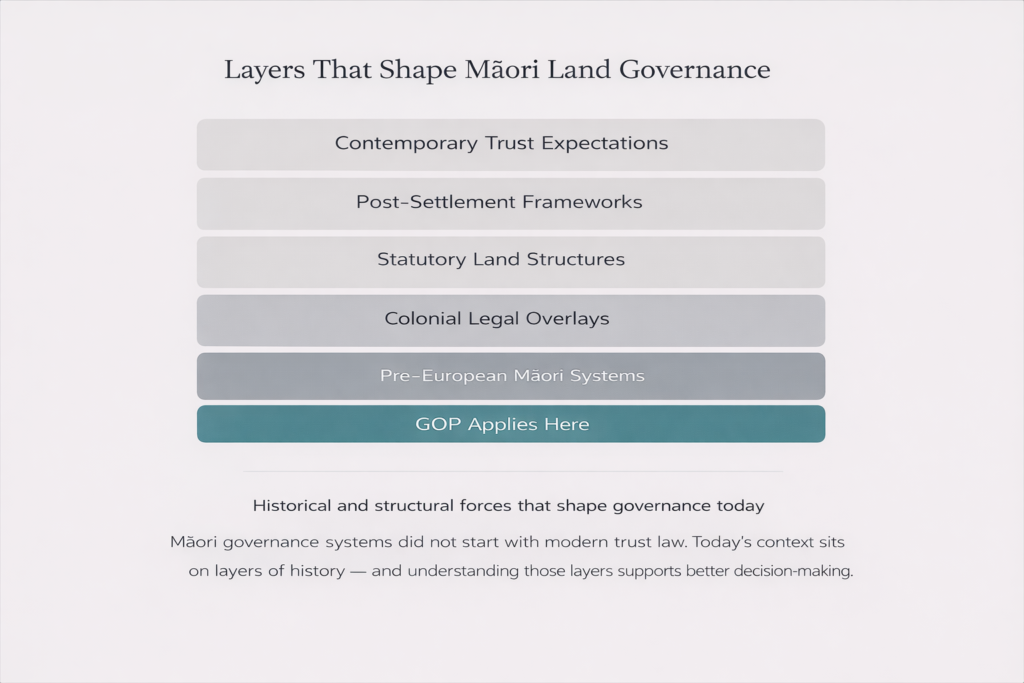
Historical & Structural Context
Te Horopaki Hītori me te Hanganga
How inherited land, collective ownership, and modern legal systems created today’s governance challenges — and why operational clarity now matters more than ever.
He whakamārama mō te huarahi i ahu mai ai ngā whenua tuku iho, te pupuri ā-rōpū, me ngā pūnaha ture hou ki ngā wero whakahaere o nāianei — me te take e tino hira ai te mārama whakahaere i tēnei wā.
Reference • Non-adversarial • Long-view Tohutoro • Kāore he tautohe • Tirohanga roaFrom Collective Stewardship to Fragmented Ownership
Mai i te Kaitiakitanga ā-Rōpū ki te Wehenga Rangatiratanga
Historically, Māori land and assets were held collectively, governed through whakapapa, tikanga, and lived responsibility rather than written registries.
I ngā wā o mua, i puritia ngā whenua me ngā rawa Māori i raro i te mana ā-rōpū, i whakahaerehia mā te whakapapa, te tikanga, me te kawenga ā-tinana — ehara i te rēhita ā-tuhi.
The introduction of formal land courts and title systems translated collective stewardship into individualised shares. While legally legible, this change unintentionally created long-term complexity.
Nā te urunga mai o ngā kōti whenua me ngā pūnaha taitara, ka hurihia te kaitiakitanga ā-rōpū hei hea takitahi. Ahakoa he mārama ā-ture, ka puta he uauatanga mō te wā roa.
Administrative Dilution Over Time
Te Memehatanga Whakahaere i te Roanga o te Wā
Over generations, shares multiplied through succession. Decision-making authority did not disappear — but it became slower, heavier, and increasingly dependent on courts and professionals.
I te roanga o ngā reanga, ka tokomaha ake ngā hea mā te tuku iho. Kāore te mana whakatau i ngaro — engari ka pōturi, ka taumaha, ā, ka tino whakawhirinaki ki ngā kōti me ngā mātanga.
Power was not removed directly — it was diluted administratively.
Kāore te mana i tangohia tōtika — engari i memeha mā ngā tukanga whakahaere.
The Modern Legal Paradox
Te Raru o te Ture Hou
Modern law seeks to protect land, prevent abuse, and ensure fairness. As a result, systems are cautious by design — layered with checks, proofs, and procedural safeguards.
Ko te whāinga o te ture hou he tiaki i te whenua, he aukati i te whakamahi hē, ā, he whakarite i te tōkeke. Nā konei ka tino tūpato ngā pūnaha, ka maha ngā arowhai me ngā taunakitanga.
While legally sound, these safeguards often assume the existence of strong operational systems. Where those systems are absent, compliance remains — but momentum stalls.
Ahakoa he tika ā-ture ēnei whakaritenga, e whakapae ana he pūnaha whakahaere kaha kē tō te tarahiti. Ki te kore aua pūnaha, ka ū tonu ki te ture — engari ka tū te nekehanga.
Where the Gap Emerged
Te Wāhi i Puta ai te Āputa
Most trusts were never given practical tools to manage scale, succession, and engagement across generations. People carried systems in their heads.
Kāore te nuinga o ngā tarahiti i whakawhiwhia ki ngā taputapu whakahaere hei kawe i te rahi, te tuku iho, me te whai wāhi o ngā reanga maha. I kawea ngā pūnaha e te tangata anake.
- Records depended on individuals
- Succession intent remained informal
- Dividend pathways were unclear
- Silence became mistaken for agreement
- I whakawhirinaki ngā rēhita ki te tangata
- I noho ā-waha noa ngā hiahia tuku iho
- Kāore i mārama ngā ara tohatoha hua
- I rangona te puku hei whakaae
Why Operational Clarity Matters Now
Te Take e Hira ai te Mārama Whakahaere i Nāianei
The Governance Operating Plan responds to this history without attempting to rewrite it. It works alongside existing law, not against it.
E whakautu ana te GOP ki tēnei hītori, engari kāore e ngana ki te whakahou. Ka mahi tahi me te ture o nāianei, ehara i te whakahē.
Operational clarity does not change ownership — it makes stewardship possible again.
Kāore te mārama whakahaere e whakarerekē i te rangatiratanga — engari ka whakahoki i te āheinga ki te tiaki.