
Common Pitfalls
Many website problems are governance problems in disguise.
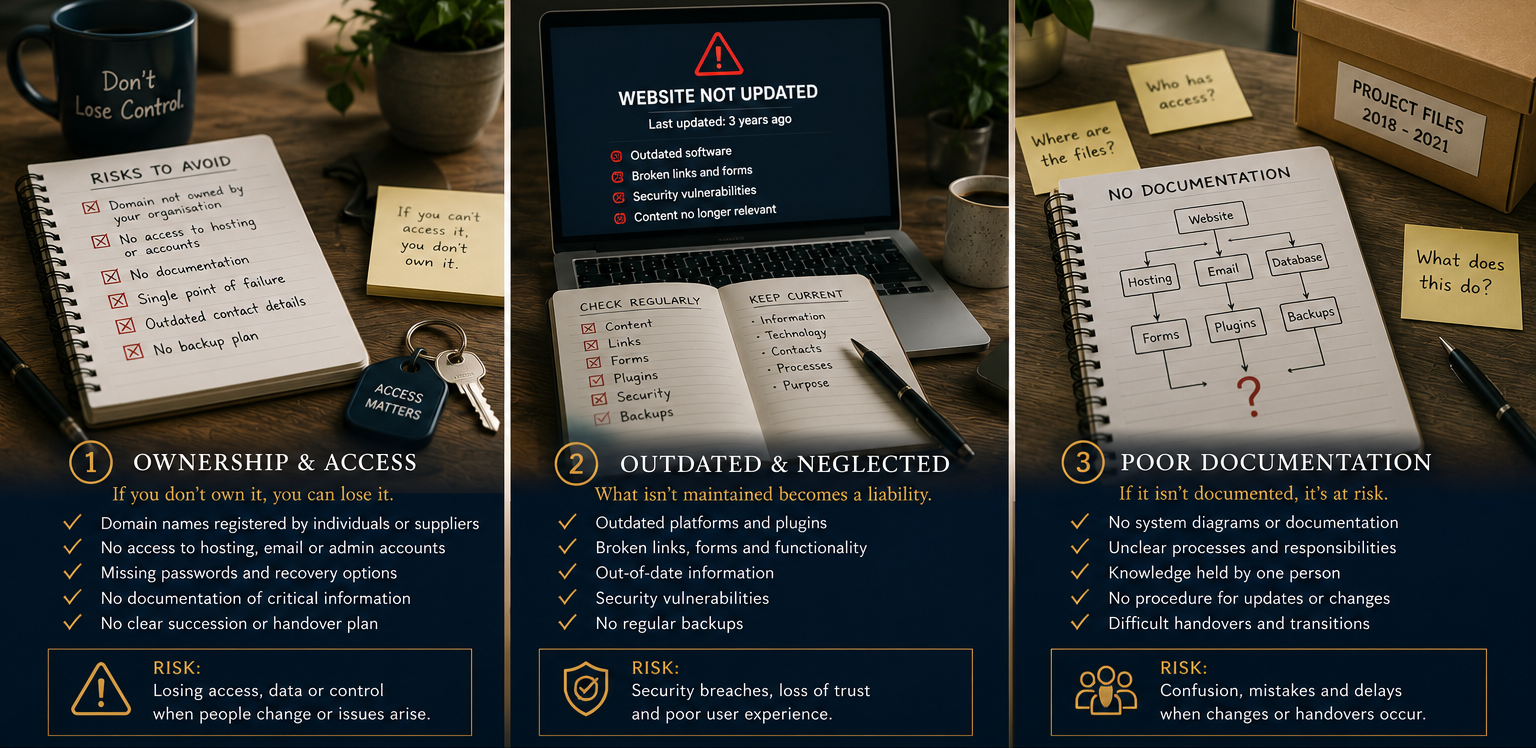
Most organisations do not experience difficulties because of technology. They experience difficulties because ownership, responsibility, access and continuity were never properly considered.
Understanding a few common pitfalls can save significant time, money and frustration.

The Most Common Mistakes
Pitfall #1
Who Owns The Domain?
Years later nobody remembers who registered the domain, where it is managed or how to access it.
Better Practice
Keep domain ownership records, administrator details and renewal responsibilities documented.
Pitfall #2
One Person Controls Everything
A volunteer, committee member or supplier becomes the sole holder of passwords and knowledge.
Better Practice
Share responsibility appropriately and ensure key information is documented and accessible.
Pitfall #3
No Backups
Content, photographs and records are lost because backup systems were never established or tested.
Better Practice
Maintain regular backups and ensure they can be restored if required.
The Vendor Lock-In Problem
Some organisations become dependent on a supplier because they do not control their domain, hosting account or administrative access.
This can make future changes expensive, difficult or impossible without external assistance.
Good relationships with suppliers are valuable. Dependence is not.
Ownership Risk
Critical digital assets are controlled by others.
Knowledge Risk
Nobody understands how the system works.
Continuity Risk
Key people leave and capability disappears with them.

Outdated Websites
A website does not become outdated because it is old.
A website becomes outdated when information is inaccurate, ownership is unclear, access is lost or the platform no longer supports organisational needs.
Sometimes a simple refresh is all that is required. Sometimes a more comprehensive review is appropriate.
Technology Is Rarely The Real Problem
Most issues can be traced back to planning, ownership, documentation or governance.
Technology changes over time. Good stewardship principles remain remarkably consistent.
Reactive Approach
Problems are addressed only after something goes wrong.
Proactive Approach
Ownership, access, backups and continuity are reviewed before issues arise.
The Good News
Most of these pitfalls are avoidable.
They do not require advanced technical knowledge. They require awareness, planning and sensible documentation.
Build, Buy Or Support?
Once the risks are understood, organisations can consider the different pathways available to them.
Explore Build • Buy • Support