
Digital Assets
Some of the most valuable assets now exist entirely in digital form.
Modern organisations rely heavily on digital systems to communicate, store information, manage records and support operations.
Websites, domains, email accounts, cloud storage, databases and digital archives often contain critical organisational knowledge and capability.
Despite their importance, digital assets are frequently overlooked until a problem occurs.
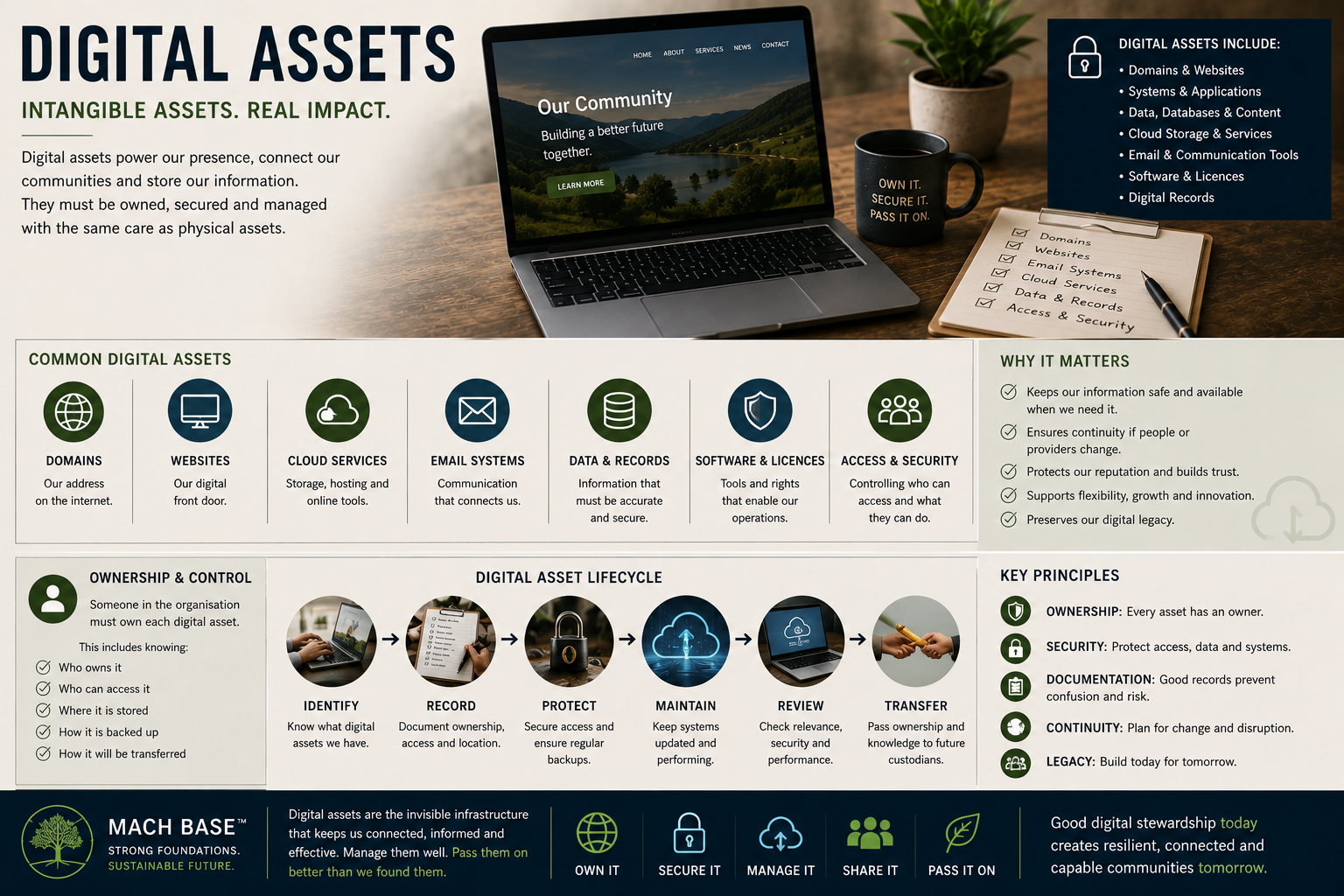
What Are Digital Assets?
Digital assets include information, systems and resources that exist electronically and contribute to organisational capability.
Some are visible to the public, such as websites. Others operate quietly in the background but remain equally important.
Effective stewardship requires understanding both.
The Ownership Question
Many organisations discover too late that they do not fully control their digital assets.
Domains may be registered in someone else’s name. Passwords may be unknown. Hosting accounts may be inaccessible.
Digital stewardship begins with understanding ownership and access.
Ownership
Who legally owns the asset?
Access
Who can log in, update and manage it?
Continuity
What happens if key people become unavailable?
Domains & Websites
Domains and websites often serve as the public face of an organisation.
They represent more than technology. They contain history, knowledge, records, communication channels and organisational identity.
Maintaining ownership and control is essential.
Email & Communication Systems
Email accounts frequently contain years of correspondence, decisions, agreements and organisational knowledge.
Losing access can have significant operational consequences.
Clear management processes help reduce this risk.
Cloud Storage & Digital Records
Increasingly, documents, photographs, reports and archives are stored online.
These systems provide convenience and accessibility but also require planning, backup procedures and clear responsibility.
Stewardship applies just as much to digital records as it does to physical ones.
The Forgotten Asset
Many organisations focus on physical assets while overlooking digital assets.
Yet websites, archives, records and communication systems often contain decades of accumulated knowledge.
Once lost, that information may be impossible to recover.
Reactive Approach
Address digital asset issues only after access is lost or systems fail.
Stewardship Approach
Document ownership, maintain access and review systems regularly.
Digital Asset Registers
A digital asset register helps organisations understand what systems exist and who is responsible for them.
Knowledge Preservation
Digital systems increasingly hold organisational memory.
Reports, photographs, videos, stories, governance records and operational knowledge are now commonly stored in digital form.
Protecting these assets supports continuity and future generations.
Digital Assets & Future Generations
Today’s digital records may become tomorrow’s archives.
The decisions made today regarding ownership, access and preservation will influence what future people are able to understand, access and build upon.
Digital stewardship is increasingly becoming an essential part of organisational continuity.
The MACH BASE Perspective
Digital assets deserve the same attention as physical assets.
Ownership should be clear. Access should be documented. Records should be protected. Knowledge should be preserved.
Effective stewardship ensures digital capability remains available long into the future.
Heritage & Knowledge Assets
Some assets hold value not because of what they do, but because of what they remember.
Explore Heritage & Knowledge Assets