EMPLOYMENT & TRAINING
Growing People
The Most Valuable Harvest
Every successful enterprise depends upon people.
Land may produce food, but communities are built through skills, knowledge, experience and opportunity.
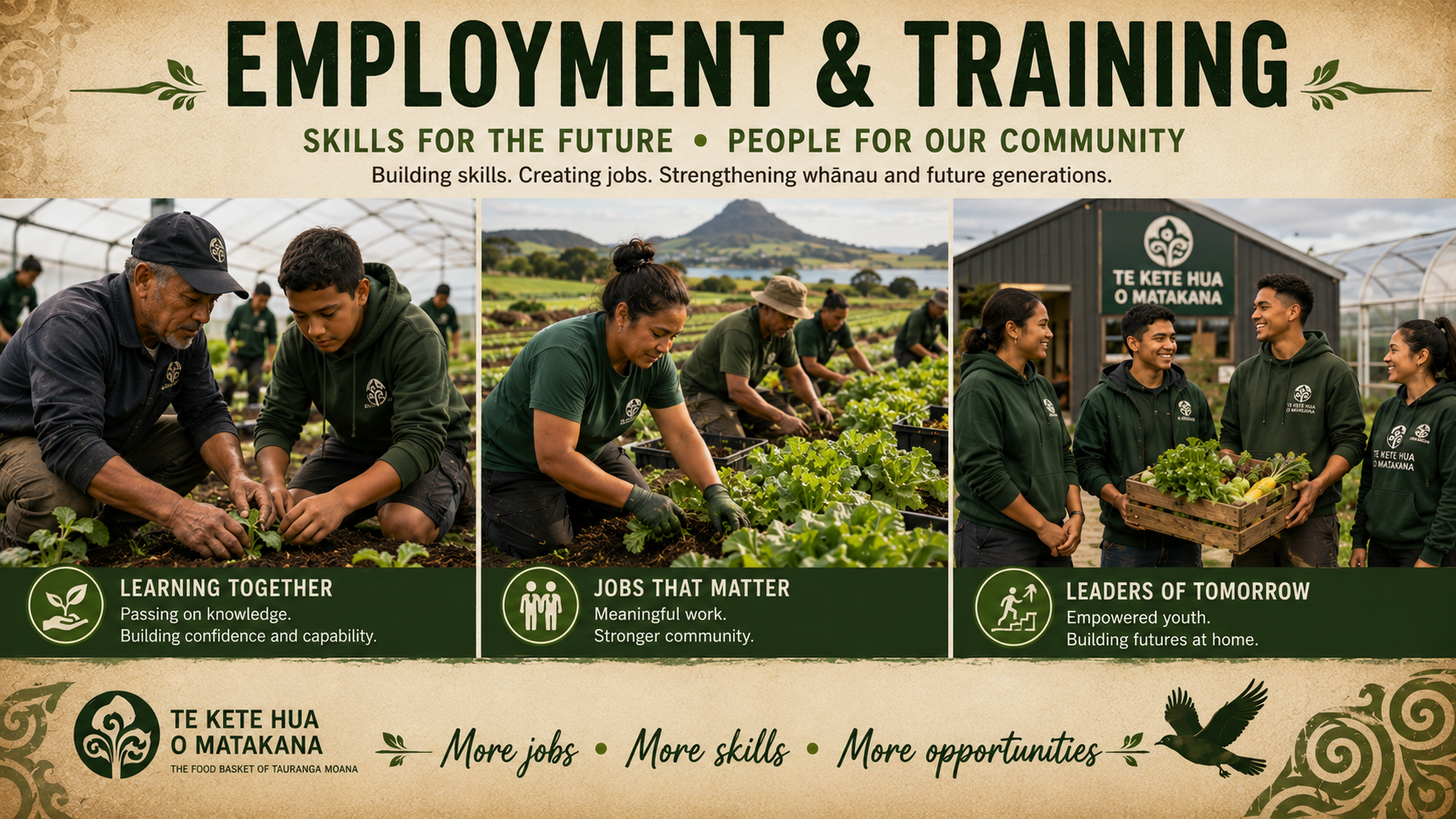
For this reason, employment and training sit at the heart of Te Kete Hua.
The greatest harvest is not produce.
It is people.
Creating Opportunity
Productive land creates more than economic returns.
It creates opportunities for people to learn, work, contribute and build meaningful futures.
Horticulture, market gardening, honey production, nursery operations and food enterprises all require a wide range of skills and experience.
Every role represents an opportunity for someone to participate in the success of their community.
Training Future Generations
One of the greatest opportunities available to any community is the ability to pass knowledge from one generation to the next.
Skills developed through productive enterprises can provide lifelong benefits.
These may include:
• Horticulture
• Nursery operations
• Beekeeping
• Farm management
• Machinery operation
• Food processing
• Logistics and transport
• Business management
• Environmental stewardship
Whānau Enterprise
Not every opportunity needs to be large-scale.
Small family enterprises have long played an important role within Māori communities.
Market gardens, honey operations, seedling production, specialty crops and local services may all provide opportunities for whānau-based businesses.
A collection of successful small enterprises can often create a strong and resilient local economy.
Retaining Talent
Many rural communities face the challenge of young people leaving in search of employment elsewhere.
While movement and exploration are valuable parts of life, thriving communities also require opportunities close to home.
Te Kete Hua encourages discussion about how future enterprises may help create pathways for those who wish to remain connected to their whenua and community.
A Community Investment
Employment is more than a pay packet.
It supports confidence, wellbeing, independence and purpose.
Training builds capability.
Capability builds opportunity.
Opportunity strengthens communities.
Growing skills.
Growing opportunity.
Growing people.
EMPLOYMENT INTENSITY
Jobs Per Hectare
Different land uses can create very different levels of employment.
Traditional pastoral farming remains important, but it generally requires fewer workers per hectare than intensive horticulture, market gardening or greenhouse production.
The question is not what should be replaced.
The question is what additional opportunities might be created.
As a general discussion point, employment intensity may be viewed in the following way:
• Dairy farming — lower employment per hectare
• Sheep and beef farming — lower employment per hectare
• Orchards — moderate employment per hectare
• Market gardening — higher employment per hectare
• Greenhouse production — very high employment per hectare
Intensive food production may support growers, trainees, seasonal workers, packhouse staff, drivers, maintenance workers, market sellers, administrators and small business owners.
Even small areas of diversified production may create meaningful opportunities for future generations.
More skills.
More jobs.
More reasons to stay connected to the whenua.