
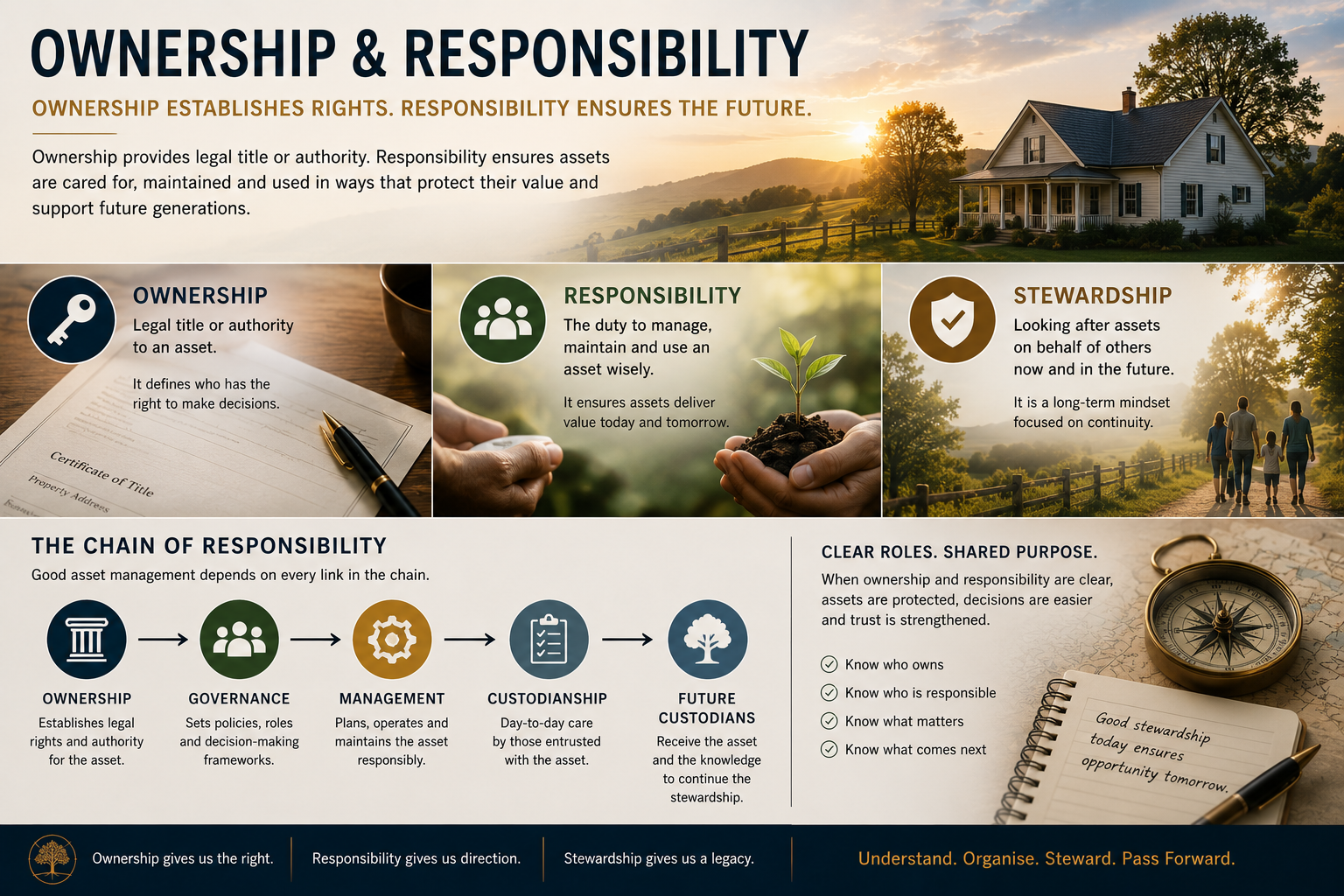
Ownership & Responsibility
Understanding who owns assets is only the beginning.
Every asset has an owner, but effective stewardship requires more than ownership alone.
Assets must also be managed, maintained, protected and reviewed. These responsibilities are often shared across trustees, managers, staff, volunteers, families and future custodians.
Understanding these roles helps reduce risk while improving continuity and accountability.
Ownership Is Not Stewardship
Many organisations focus on who owns an asset.
Equally important is understanding who is responsible for maintaining records, reviewing condition, managing access and supporting continuity.
Ownership establishes rights. Stewardship establishes responsibilities.
Own
Establish legal ownership and authority.
Manage
Oversee day-to-day use and administration.
Protect
Preserve value, capability and continuity.
Common Questions
Organisations often discover that asset ownership is not always as clear as expected.
The Four Responsibility Layers
Most assets involve several layers of responsibility.
Understanding these layers helps organisations reduce confusion and improve continuity.
Ownership
Legal authority and ultimate responsibility for the asset.
Governance
Strategic oversight, policies and long-term direction.
Management
Day-to-day administration, maintenance and coordination.
Custodianship
Practical care, protection and continuity.
Examples Of Ownership Structures
Ownership arrangements vary significantly between organisations.
Knowledge Ownership
Some of the most valuable assets exist within people.
Procedures, expertise, historical understanding and practical experience often reside with a small number of individuals.
When knowledge is not documented, organisations become vulnerable to unexpected change.
The Single Person Risk
Many organisations unknowingly rely on one individual who understands a critical system, asset or process.
If that person retires, moves on or becomes unavailable, valuable capability can disappear overnight.
Good stewardship reduces this risk through documentation, succession planning and knowledge transfer.
Document
Capture key information before it is lost.
Share
Build capability across multiple people.
Transfer
Prepare future custodians for responsibility.
The MACH BASE Perspective
Effective asset management requires clarity.
Ownership should be understood. Responsibilities should be documented. Knowledge should be shared. Future custodians should be prepared.
The goal is not simply to control assets, but to ensure they remain useful, understood and sustainable over time.
Registers & Records
Once ownership and responsibilities are understood, the next step is creating reliable records.
Explore Registers & Records