
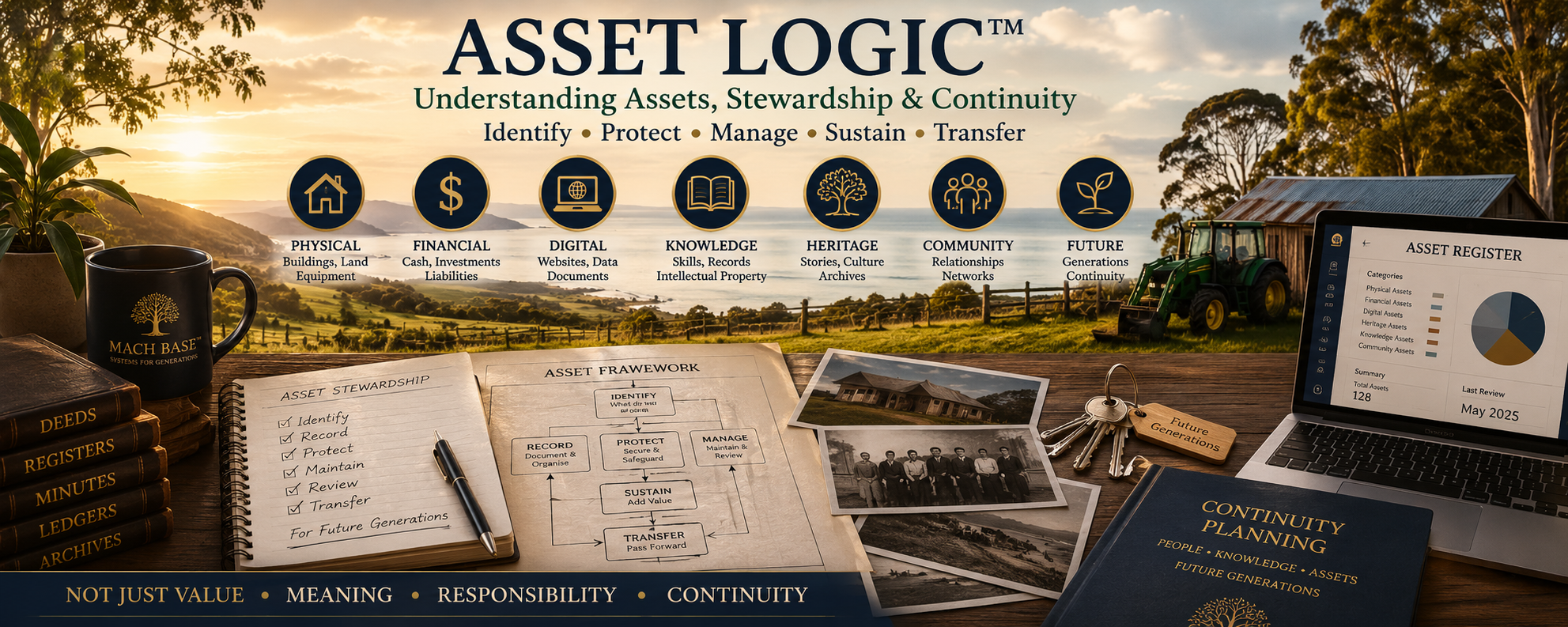
Understanding Assets
Before assets can be managed, they must first be understood.
The word “asset” is often associated with money, property or investments. While these are important examples, assets exist in many forms and often extend far beyond financial value.
Assets can include physical resources, digital information, knowledge, heritage, relationships and community capability. Understanding these different categories is the foundation of effective stewardship.
What Makes Something An Asset?
An asset is anything that provides value, supports capability or contributes to future outcomes.
Some assets generate income. Others preserve knowledge, support decision-making, strengthen communities or protect cultural identity.
The most valuable assets are not always the easiest to measure.
Value
Assets contribute to the wellbeing, capability or sustainability of an organisation.
Purpose
Assets exist to support objectives, responsibilities and future plans.
Continuity
Assets help ensure future generations can build upon what already exists.
Seven Common Asset Categories
While every organisation is different, most assets fall within several broad categories.
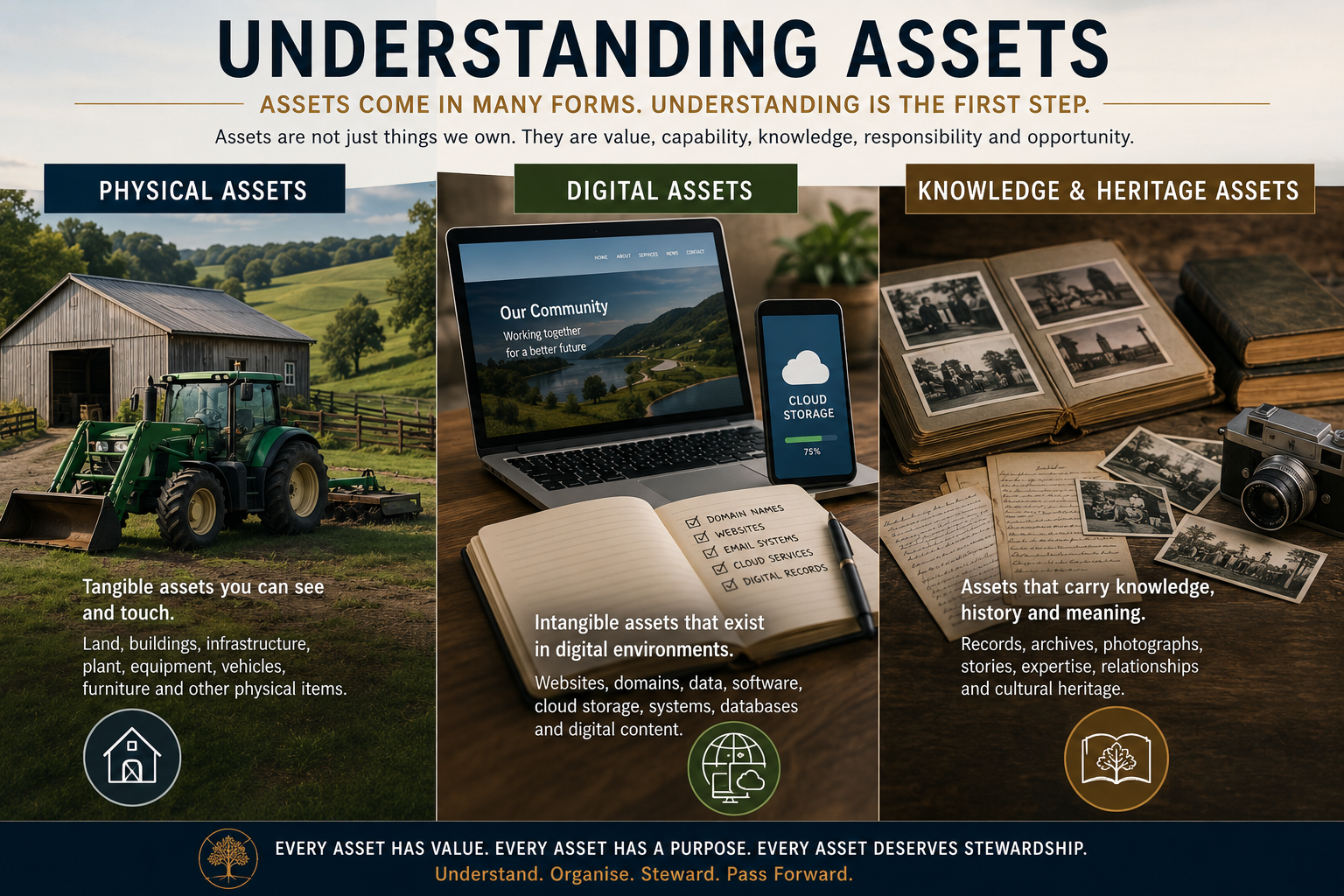
Physical Assets
Physical assets include land, buildings, vehicles, machinery, equipment and infrastructure.
These are often the easiest assets to identify because they can be seen, measured and recorded.
Financial Assets
Financial assets include cash reserves, investments, shares, trust funds and other resources that contribute to organisational sustainability.
Financial assets often support the maintenance and development of other asset categories.
Digital Assets
Modern organisations increasingly rely on digital assets.
Websites, domains, email systems, cloud storage, databases and digital records often contain critical information and operational capability.
Without proper stewardship, digital assets can be easily lost or become inaccessible.
Knowledge Assets
Knowledge assets include experience, expertise, procedures, lessons learned and organisational memory.
These assets often reside within people and are easily lost when not documented or shared.
Heritage Assets
Heritage assets include archives, photographs, oral histories, cultural records, traditions and stories.
These assets help communities understand where they came from and preserve identity over time.
Community Assets
Relationships, partnerships, volunteers, networks and community capability are valuable assets that contribute to resilience and success.
These assets are often overlooked because they do not appear on financial statements.
Future Assets
Some assets exist not for current benefit but for future generations.
Environmental restoration projects, educational initiatives, archives and long-term stewardship programmes all contribute to future capability.
The Hidden Assets
Organisations frequently focus on what they can easily see and measure.
Yet some of the most important assets are hidden within people, stories, relationships and accumulated knowledge.
Understanding these assets is often the first step towards protecting them.
Identify
Understand what exists.
Record
Capture information clearly.
Protect
Preserve assets for future use.
Ownership & Responsibility
Understanding assets naturally leads to questions of ownership, stewardship and accountability.
Explore Ownership & Responsibility