Registers & Records
If an asset is not recorded, it may eventually be forgotten.
Asset registers and records form the foundation of effective stewardship.
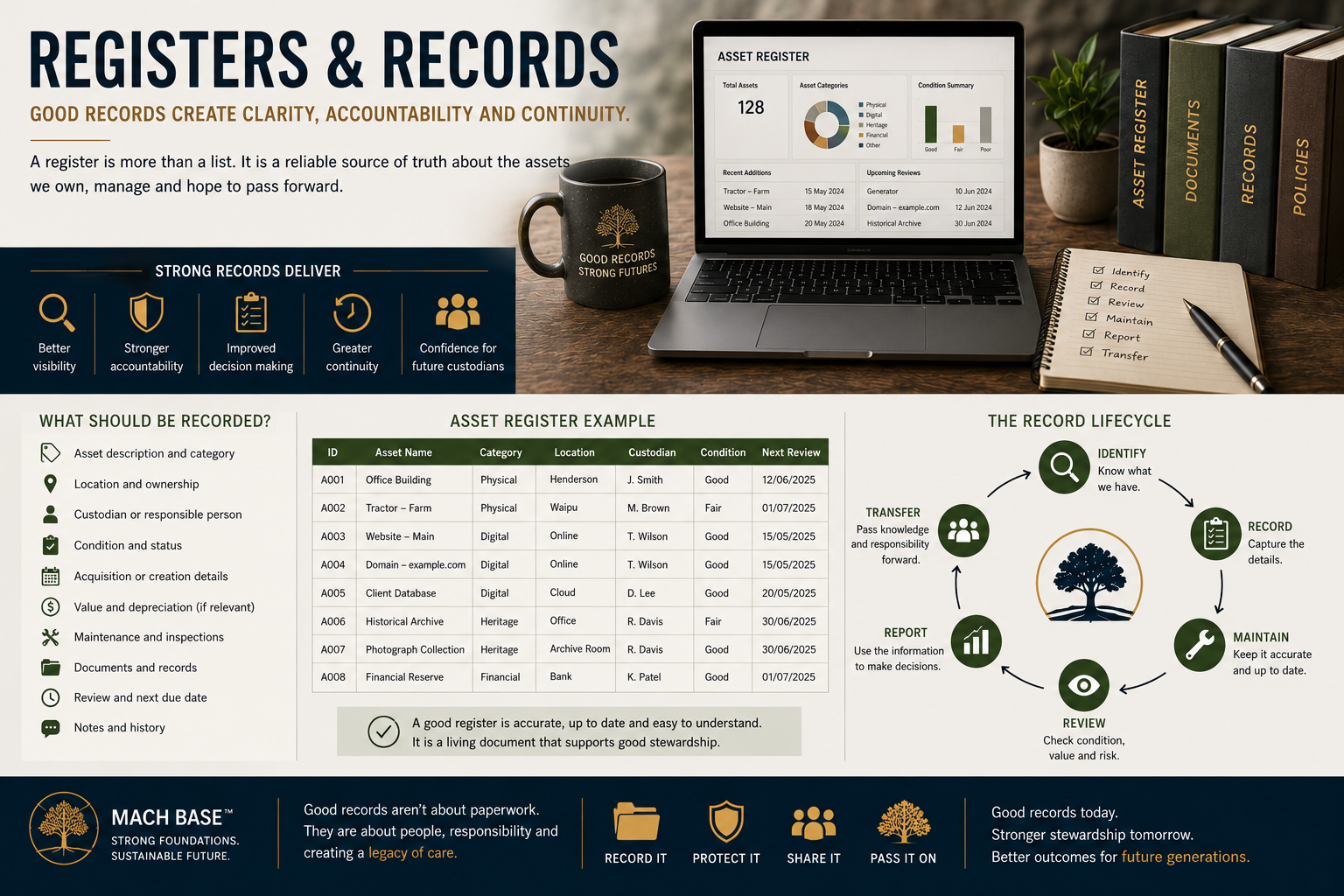
They help organisations understand what assets exist, where they are located, who is responsible and what actions may be required to maintain them.
Good records support accountability, reduce risk and improve continuity.
Why Registers Matter
Organisations often possess more assets than they realise.
Over time, records become scattered, knowledge is lost and responsibilities change.
Asset registers provide a structured way to organise information and ensure important resources remain visible and understood.
Visibility
Understand what assets exist and where they are located.
Accountability
Clarify ownership, responsibility and stewardship.
Continuity
Ensure knowledge remains available over time.
What Information Should Be Recorded?
The level of detail will vary depending on the organisation and asset type.
At a minimum, most registers should answer several basic questions.
Examples Of Asset Registers
Different asset categories often require different register types.
Simple Is Better Than Perfect
Many organisations delay creating registers because they believe they need a complex system.
In reality, a simple register that is regularly maintained is often more valuable than a sophisticated system that nobody updates.
The objective is clarity, not complexity.
Simple Register
Easy to understand, easy to maintain and easy to share.
Complex Register
Powerful when maintained correctly, but often dependent on specialist knowledge.
Records Support Decisions
Registers are not simply lists.
They provide information that supports planning, budgeting, maintenance, governance and long-term stewardship.
Good records help organisations make informed decisions based on facts rather than assumptions.
The Hidden Risk
Assets that are not documented often become vulnerable.
Maintenance may be overlooked. Ownership may become unclear. Historical knowledge may disappear.
Registers help ensure important information remains visible and accessible.
Record
Capture essential information.
Review
Confirm information remains current and accurate.
Maintain
Update records as assets evolve over time.
The MACH BASE Perspective
Asset registers are among the simplest and most effective stewardship tools available.
Whether managing land, machinery, archives, digital systems or organisational knowledge, the principle remains the same:
Know what exists. Record it clearly. Review it regularly.
From Registers To Stewardship
Registers tell us what exists.
Stewardship determines how those assets are maintained, protected and passed forward.
Physical Assets
Land, buildings, equipment and infrastructure often form the backbone of organisational capability.
Explore Physical Assets