
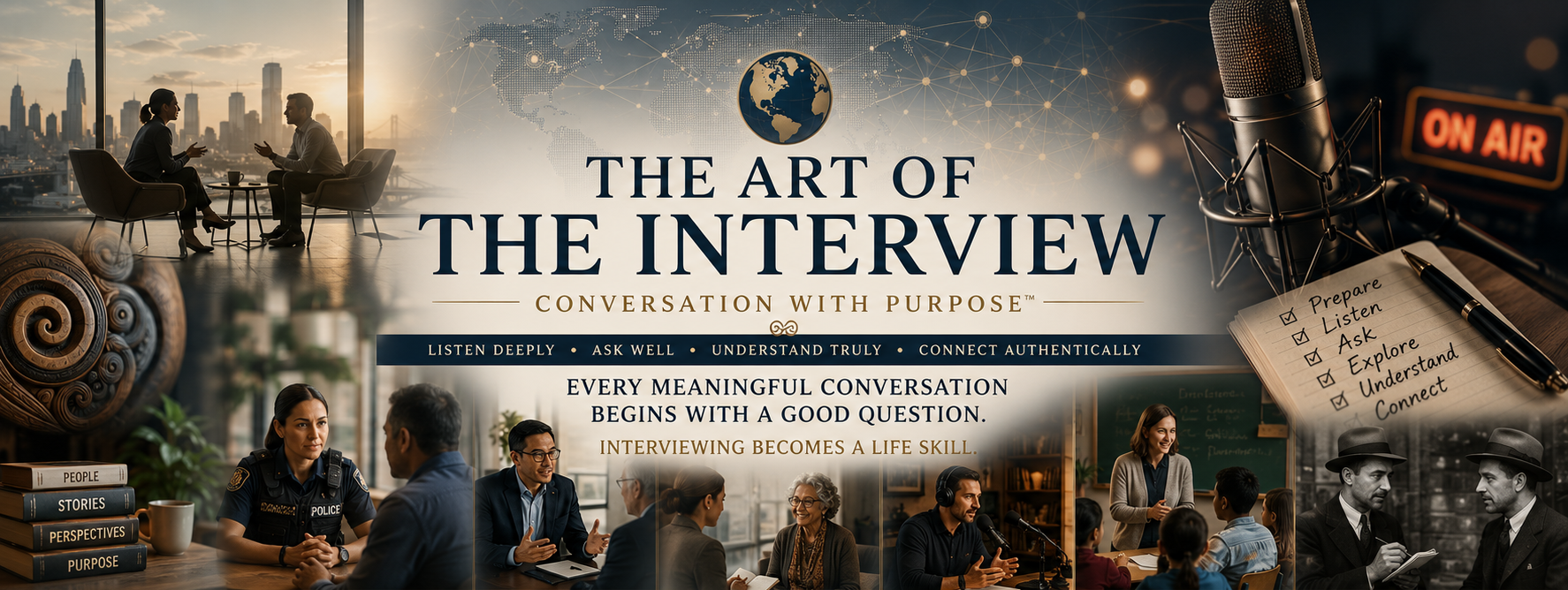
One Skill. Many Applications.
The setting changes. The principles remain remarkably consistent.
Interviews occur wherever people seek understanding. Although every profession develops its own procedures and terminology, successful interviews consistently rely upon preparation, trust, listening, observation and thoughtful questions.
Understanding the purpose of each interview helps determine its structure, pace and style.
Investigative
Designed to establish facts, clarify events and improve understanding. Accuracy, objectivity and careful documentation are essential.
Employment
Focused on suitability, capability, experience and cultural fit. Preparation benefits both interviewer and candidate.
Media
Radio, television and podcast interviews seek to inform, educate or entertain through engaging conversation and thoughtful storytelling.
Every Interview Has a Different Purpose
The questions asked during a police interview differ from those used in a podcast or business meeting. Yet beneath these differences lie the same fundamental communication skills.
Purpose determines method. Understanding determines success.
Business & Discovery
Understanding Before Solutions
Consultants, advisors and business leaders begin by discovering needs, objectives and challenges before recommending solutions. Listening often provides greater value than presenting.
Research & Education
Exploring Knowledge
Researchers, teachers and students use interviews to collect experience, expand understanding and preserve knowledge for future learning.
Common Interview Environments
Formal Interviews
Structured interviews usually follow established procedures, documentation standards and clearly defined objectives.
Semi-Structured Interviews
Prepared questions provide direction while allowing flexibility to explore unexpected topics as they emerge.
Conversational Interviews
Informal interviews rely upon rapport and curiosity. Although less structured, they still benefit from preparation, purpose and attentive listening.
Choosing the Right Approach
No single interview style suits every situation. The best interviewers adapt their approach according to the objective, the individual, the environment and the information being sought.
Flexibility is not inconsistency. It is professional judgement applied to changing circumstances.
One Conversation Can Change Everything
A successful interview may lead to employment, solve a problem, preserve history, build understanding, strengthen relationships or simply help another person feel genuinely heard.
Every interview deserves thoughtful preparation and genuine respect.
Experience Is the Greatest Teacher
Real examples bring interview principles to life. Explore practical case studies drawn from a wide range of professional and everyday situations.
Continue to Case Studies