
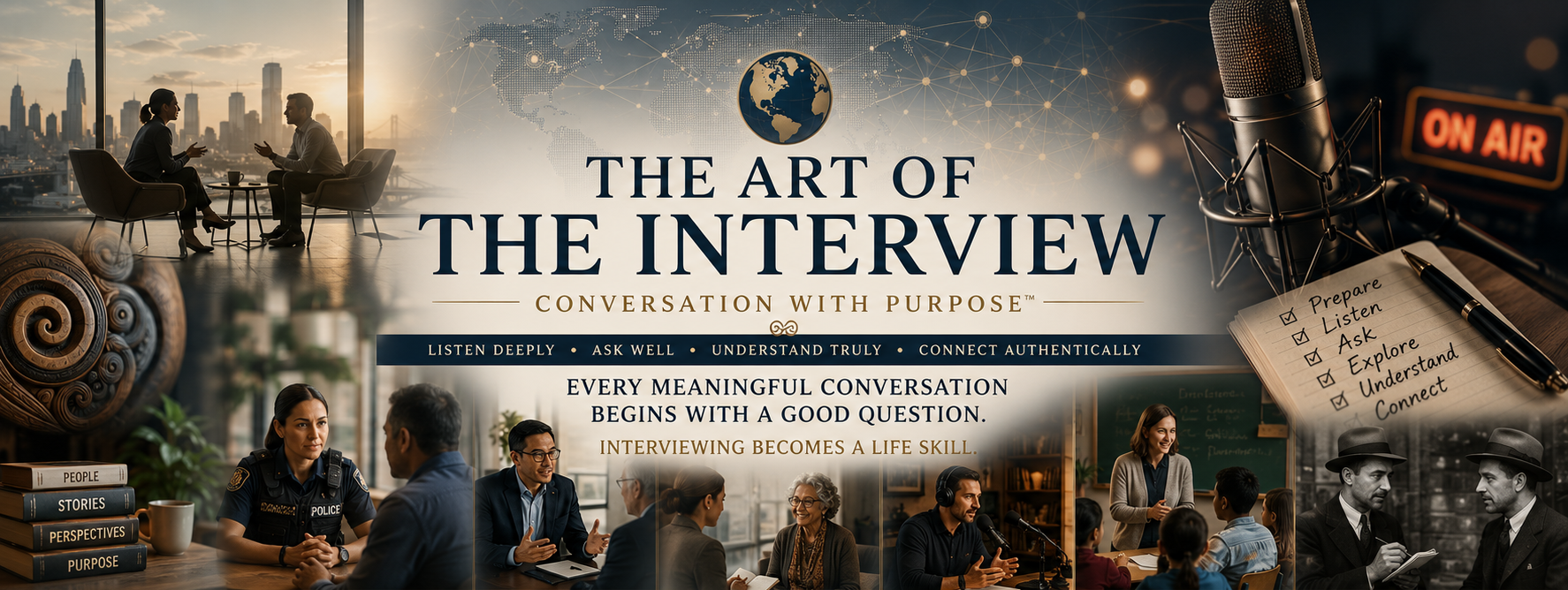
Hear More Than Words
The greatest interviewers are remembered for how well they listened.
Questions begin conversations. Listening gives them meaning. Many interviewers concentrate so heavily on asking the next question that they miss the most important part of the conversation—the answer itself.
True listening requires attention, patience, observation and the discipline to allow another person to complete their thoughts without interruption.
Listen Completely
Allow people to finish speaking before forming your next question. Understanding improves when listening becomes your primary focus rather than your opportunity to speak.
Observe Carefully
Meaning is communicated through posture, facial expression, pace, hesitation, confidence, enthusiasm and silence. Observation provides valuable context alongside spoken words.
Remain Present
Avoid thinking ahead. Stay fully engaged with the conversation taking place rather than preparing your next question while the other person is still speaking.
Listening Is Active
Good listeners do not simply hear words. They organise information, recognise patterns, identify inconsistencies, notice emotion and understand where clarification may be required.
Listening is an active professional skill rather than a passive activity.
Observe Behaviour
Context Matters
Body language should never be interpreted in isolation. People communicate differently according to personality, culture, confidence, stress and circumstance. Observation supports understanding rather than replacing evidence.
Notice Change
Look for Shifts
Changes in tone, pace, confidence or emotional expression often indicate areas worthy of respectful exploration. Sometimes a pause reveals more than a paragraph.
The Value of Silence
Silence is often uncomfortable for inexperienced interviewers. Experienced interviewers recognise that thoughtful silence creates space for reflection. Many of the most honest and insightful responses arrive after a brief pause.
Do not rush to rescue every silence. Give people permission to think.
Clarify
If something appears unclear, respectfully ask for further explanation. Clarification improves accuracy and reduces misunderstanding.
Reflect
Summarising key points allows both people to confirm shared understanding before moving forward. Reflection strengthens communication and trust.
Follow the Story
Prepared questions provide structure, but attentive listening often reveals unexpected paths that become the most valuable parts of the interview.
Listening Habits
Listening Creates Trust
People recognise when they are genuinely being heard. Respectful listening encourages openness, reduces defensiveness and often creates stronger conversations than even the most carefully prepared questions.
The interviewer who listens well rarely needs to dominate the conversation. Understanding naturally follows.
Every Conversation Has Its Own Purpose
The next section explores how interview techniques adapt across different professions, environments and situations.
Continue to Interview Types