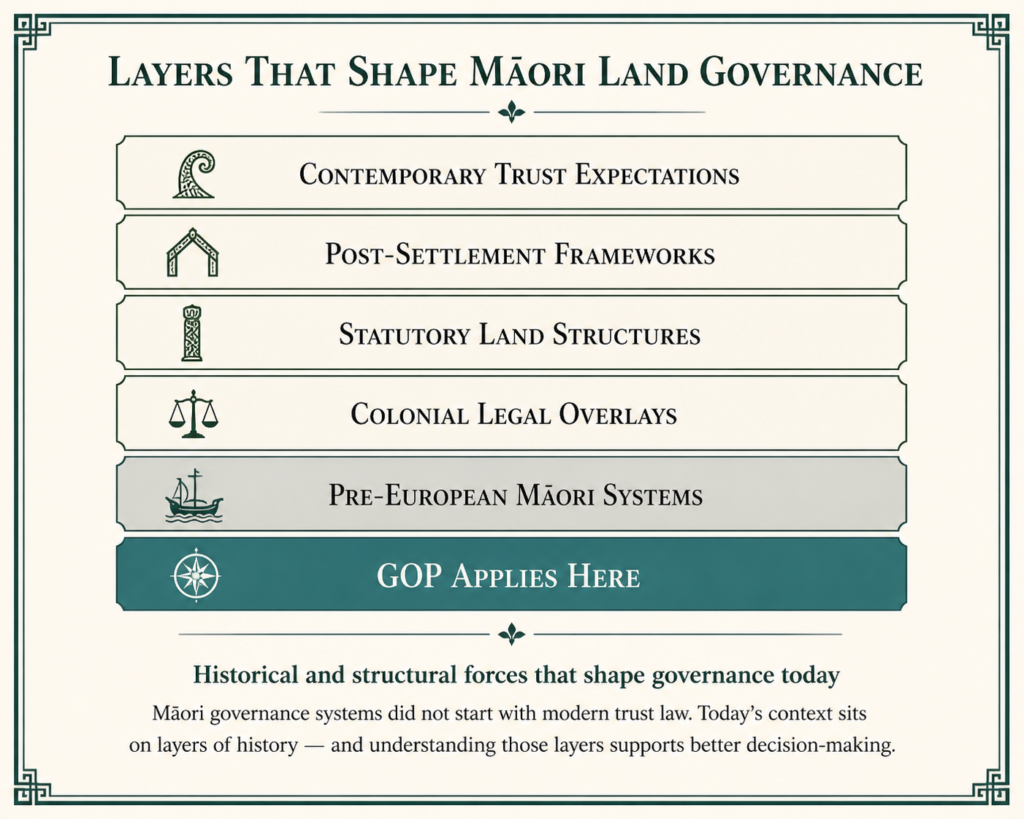
Historical & Structural Context
Te Horopaki Hītori me te Hanganga
How inherited land, collective ownership, and modern legal systems created today’s governance challenges — and why operational clarity now matters more than ever.
He whakamārama mō te ahunga mai o ngā whenua tuku iho me ngā pūnaha ture ki ngā wero whakahaere o nāianei — me te take e hira ai te mārama whakahaere i tēnei wā.
Reference: Non-adversarial • Long-view
Tohutoro: Kāore he tautohe • Tirohanga roa
From Collective Stewardship to Fragmented Ownership
Mai i te Kaitiakitanga ā-Rōpū ki te Wehenga Rangatiratanga
Historically, Māori land and assets were held collectively, governed through whakapapa, tikanga, and lived responsibility rather than written registries.
I ngā wā o mua, i puritia ngā whenua Māori i raro i te mana ā-rōpū, ā, i whakahaerehia mā te whakapapa me te tikanga.
The introduction of formal land courts translated this into individualised shares — creating long-term complexity.
Nā te urunga mai o ngā kōti whenua ka hurihia tēnei hei hea takitahi — ā, ka puta he uauatanga mō te wā roa.
Administrative Dilution Over Time
Te Memehatanga Whakahaere
Over generations, shares multiplied. Authority remained — but became slower and heavier.
I te roanga o ngā reanga ka tokomaha ake ngā hea — ka noho tonu te mana, engari ka pōturi.
Insight: Power was not removed — it was diluted administratively.
Kōrero matua: Kāore te mana i tangohia — engari i memeha mā te whakahaere.
The Modern Legal Paradox
Te Raru o te Ture Hou
Modern law protects ownership — but assumes strong operational systems.
Ka tiaki te ture hou i te whenua — engari ka whakapae he pūnaha whakahaere kaha.
Reality: Compliance remains — but momentum stalls.
Te āhua: Ka ū ki te ture — engari ka tū te nekehanga.
Where the Gap Emerged
Te Āputa
- Records depended on individuals
- Succession remained informal
- Dividend pathways unclear
- Silence mistaken for agreement
- I whakawhirinaki ngā rēhita ki te tangata
- I noho ā-waha noa ngā tuku iho
- Kāore i mārama ngā ara hua
- I rangona te puku hei whakaae
Why Operational Clarity Matters
Te Hira o te Mārama Whakahaere
Key idea: Operational clarity does not change ownership — it restores stewardship.
Mātāpono: Kāore te mārama e whakarerekē rangatiratanga — engari ka whakahoki kaitiakitanga.